Showing posts with label Adventures. Show all posts

Friday, April 4, 2014

Kilimanjaro, Day 6 - Summit Day

February 3, 2014

Kilimanjaro, Day 6: Summit Day

It all started with a loud knocking on our tent at precisely 12:15am, which was the wake-up time we had negotiated.  We had slept in the majority of our gear to stave off the biting cold that permeates everything at 15,331 feet, so there wasn't much to do, except activate our foot and hand warmers, and attempt to force down some breakfast.  We gathered in the mess tent, nervously sipping our hot drinks and nibbling our power bars, but no one had much of an appetite, partly because of the altitude, but mostly because we were all on edge.  There was a nervous energy hanging over us, as we prepped ourselves for this final ascent, as we were all too aware of what was waiting for us out there at the trailhead.

We began our final 4,010 foot ascent to the roof of Africa at 1:00am, in the pitch black and bitter cold of night.  As we approached the trailhead, we could see lines of tiny headlamps further up the mountain, all belonging to hikers who had started much earlier than we; their presence more intimidating than comforting, as they seemed so far away.  Eventually, we would pass most of those lights, not out of competition, but as a result of our strong, steady pace.  But, first, we started this hike just as we had every other hike on the mountain.  Pole, pole.  Slowly, slowly.

This time, we moved more slowly than anyone at sea-level could ever imagine.  We were already above 15,000 feet, so the simplest task required monumental effort.  Even drinking from my Camelback took my breath away, making climbing the mountain seem an impossible feat.  So, rather than get discouraged, I took it one step, and one breath, at a time.

The world around us was so densely black that we couldn't see the landscape ahead, or anywhere else around us.  Our vision was limited to the infinitesmally small area illuminated by our headlamps, thus our world became no more than the ground directly in front of our feet.  Talking was too much effort, and wasted precious oxygen, so we all put our heads down, and silently made our way up the mountain, one small step at a time.  Pole, pole.  Slowly, slowly.

The complete darkness, in combination with the ever-depleting oxygen levels, proved a powerful hallucinogen for me.  I kept seeing things in my peripheral vision - flutters of light and other vibrant colors not grounded in reality - and would turn my head to seek out their source, only to find myself so light-headed and dizzy that I was in danger of blacking out.  I also began hearing things - little chatters of laughter and far-off bits of conversations that probably weren't really taking place.  (Or maybe they were.  I'll never know.)  It was disconcerting to realize my mind was playing tricks on me, especially knowing that an altered mental status is one of the earliest signs of altitude sickness.  I didn't want my mind to go there.  The climb itself was already difficult enough; I didn't want to be preoccupied with whether or not I was getting sick.  So, I popped in my earbuds, turned on my iPod, and lost myself in the the playlist I had made just for this occasion.  Thankfully, it worked.  The music drowned out the heavy breathing and complaints of those around me, giving me something to concentrate on, rather than my own doubts and misery.  It allowed me to focus on me.

After that, my only intentional thought was to watch the feet of our guide, Richard, as he lead us up the mountainside, step by step.  Pole, pole.  Slowly, slowly.  All I had to do was place my feet exactly where he had placed his, focus on my breathing, and listen to my music.  My world became that limited and that incredibly simple.

My strategy was a success.  Before I knew it, we had been climbing for two hours.  Then three.  It was impossible to judge our progress from the landscape around us; we had the darkness to thank for that.  Our only marker of success was time, so we clung to what our watches told us, with each digit becoming our lifeline.

Soon enough, we were able to make out the ridge above us, thanks to the ant-like procession of headlamps progressing along its edge.  And, soon after that, we found ourselves at Stella Point, which at 18,680 feet, was only 660 feet short of the peak.  I don't think I've ever felt so relieved.  And, yet, we still weren't done.

And then, ever so slowly, the sun began to edge its way over the horizon, turning the once-black sky into brilliant layers of indigo, orange, and crimson.  Step by step, we crept towards the peak.  Little by little, the sky continued to lighten.  Finally, we were able to see our surroundings - the mighty glaciers, snowfields, and craters that make Kilimanjaro the magnificent feat of nature that it is.  Saying it was breathtaking doesn't do it justice.  Saying it was life-altering is only the beginning.

By the time the sun rose, illuminating everything around us, my head felt surprisingly clear and my breathing normalized.  I'm not sure if it was the adrenaline, or the benefit of being allowed to walk on a flat surface for a few minutes, but I felt amazingly well for being at such an incredibly high altitude.  Mouse, on the other hand, was not fairing so well.  He had opted not to take Diamox, and it showed.  I could see he was suffering, weaving along the trail like a drunkard, complaining of a pounding headache, and I was worried.  He was hurting, making his experience nothing like mine.  But, as bad as I felt for him, I couldn't help but be elated.  After 5 1/2 hours, we had made it.  We were at the top of Kilimanjaro!

But 19,340 feet is not an altitude that one stays at for long, so our celebration was short-lived.  We quickly took our pictures.  We high-fived.  We celebrated.  And then we headed back down the mountain.

So now, I'm lying in our tent at Mweka Camp, at 10,065 feet, more tired, sore, and covered in filth than I have been in  my entire life.  My back aches.  My quads are shredded.  And my body still quivers with the fatigue of today's journey.  But, in all honesty, none of that matters.  I did it.  I summited Kilimanjaro!!!

Wednesday, April 2, 2014

Kilimanjaro, Day 5

February 2, 2014

Kilimanjaro, Day 5: Karanga Camp to Barafu Camp


It's kind of incredible watching camp break down every morning.  As we hikers eat breakfast, pack our bags, and organize ourselves for the day, our porters swing into action, silently and efficiently gathering up our mess tent, sleeping bags, and other supplies into large, straw baskets and bags fashioned out of tarp, all to be carried atop their heads to the next camp.  Just as quickly as our colorful city of tents appears on the barren landscape each and every afternoon, it disappears, with only the bare rock and gravel of this mighty mountain left in our wake, like a mirage that never even existed.

Even though this same routine has taken place every morning, today's breakdown seemed even more fantastic.  Maybe it's because more and more trekkers have been converging, as the various routes are beginning to meet up, so the latest camps have become increasingly populated, creating a multi-colored sea of tents, spanning as far as the eye can see.  Or, maybe, it's because today's energy is vastly different from the previous days; the air is practically alive with excitement.  I can hear the exuberance and anticipation in everyone's voices as we prepare for today's hike.  There's a boisterousness that wasn't there before.  We've all made it this far, which, in and of itself, is an accomplishment.  But, even more exciting, is that today is the day we head to base camp, where we will rest our weary bones for a few hours before beginning our final trek to the top.  So, in all reality, this morning is the beginning of a very long and arduous twenty-four hour stretch.  This is the beginning of the end...

Wednesday, March 26, 2014

Kilimanjaro, Day 4

February 1, 2014

Kilimanjaro, Day 4: Barranco Camp to Karranga Camp

It happened again.  The beginning of today's hike was nearly a repeat of yesterday's.  Once again, I was light-headed, couldn't get my breathing under control, and became overwhelmed with frustration.  At least, this time, I knew what to expect, and was able to push my way through it without too much trouble, save for a moderate dose of crankiness.  It just isn't fun to feel so horrible, even for a short period of time.  But it isn't going to get any better; the higher we climb, the worse these symptoms are going to get.  I guess I'm just going to have to accept that the first thirty minutes on the trail are simply going to suck, which means I'm going to have to toughen up.

Today's challenge was The Breakfast Wall, which loomed over Barranco Camp, taunting us with it's steep vertical rise.  In all reality, it wasn't that much of an elevation gain, maybe 700 or 800 feet to the ridge line, but that didn't make it seem any less daunting when we were sizing it up during breakfast.  It looked exactly as the name suggests, a wall jutting straight up from the landscape, separating us from our next resting point.  It was a sheer cliff of slick, black rock, formidable in its presence alone. As we drank our morning coffee, we could see the hikers who had set out before us, tiny as ants, slowly making their way up this steep wall.  Talk about intimidating...

Once we got going, it became apparent that the wall looked much more formidable than it actually was.  Technically speaking, we weren't doing anything more difficult than I've done in any of the canyons of Utah or Nevada that we've navigated dozens of times.  But even doing something as simple as a Class 4 climb at 13,000+ feet, is more than a little taxing.  Every hand grip and foot placement is one hundred times more challenging than if I were doing it at sea-level.  It didn't take much for me to feel completely exhausted and out of breath, which quickly took its toll on my psyche.  My temper flared and I snapped at the boys, even though they were only trying to encourage me.  But in my oxygen-deprived state, I took this encouragement as mocking, and became convinced they were patronizing me.  I was fuming.  The funny thing was, I could logically recognize my bad mood was a direct result of the lack of oxygen to my brain; I just couldn't stop myself from slipping into my cranky pants.  So, rather than drive my husband and friends away, I put my head down, took a few deep breathes, and concentrated on the climbing.  In no time at all, my breathing was under control, my head began to clear, and my grouchiness subsided.  I apologized for my foul mood, and before I knew it, we were at the ridge line.


Unfortunately, reaching the top The Breakfast Wall did not mean we were done for the day.  We took a quick break, and started back on the trail, first dipping low into a valley before heading right back up another steep ridge to reach Karanga Camp at 13,106 feet, which is where we'll camp tonight.  I'm not going to say today was easy, as my brief bought with the altitude would disprove, but it wasn't exactly difficult, either.  More than anything, today felt like a slow and steady grind.  We reached camp by 11:30 am, which totaled a mere three hours of hiking.  In all honesty, the work was done nearly before we realized it had begun.  We've spent the remainder of the day relaxing, napping, and exploring camp.  We've had more than enough time to kill.

What strikes me most, here at Karanga Camp, is what a serious undertaking this expedition truly is.  Mouse and I have backpacked before, spending several days at a time in the wilderness, far from any trace of human civilization, but we've never done anything like this.  As I walk around camp, I'm simply awestruck by what a feat this adventure truly is.  I'm not sure exactly why this realization is hitting me so hard today - maybe it's because several parties converged from different trails today, making camp even more massive than usual, or maybe it's because someone we've come to know quite well was overcome with altitude sickness today, and had to be emergently escorted down the mountain.  Whatever the reason, there's no denying this is serious business.

The snow-capped top of the mountain is getting closer and closer, and it's almost scary to realize we are going to attempt to summit it in just over twenty-four hours.    We're in the thick of it now, and there is no turning back.  We're going to summit Kilimanjaro, and I'm so grateful for the hiking, climbing, and overall wilderness experience I have, as it gives me a frame of reference, helping me through the taxing hikes and ice cold nights.  Each night seems to get colder, so each night I pile on more gear.  I'm almost maxed out right now, but am saving the last and warmest pieces for tomorrow. At 13,106 feet, it's cold enough for me to see my breath as I write this, even though I'm tucked away in my tent.  And I can't leave my gloves off for long, as my fingers cramp up from the cold.  Tomorrow we'll be at greater than 15,000 feet, so it's only going to get worse.  I'm not looking forward to tomorrow's conditions, but I have to remind myself that it's all part of this journey; a piece of the puzzle that is trekking Kilimanjaro.  Soon, we'll be back at the hotel and in the heat of the lowlands, but for now this is our reality.


Wednesday, March 12, 2014

Kilimanjaro, Day 3

January 31, 2014

Kilimanjaro, Day 3: Shira Hut 2 to Lava Tower to Barranco Camp

After the sun went down last night, it got cold, cold, cold.  I guess I should have known that would happen; we were camping at 12,500 feet, after all, but the frigidness took me by surprise for some reason.  It was an unrelenting, permeating cold that followed us wherever we went.  Even the mess tent provided little respite, with our food turning ice cold the moment it hit our plates.  And this morning we were greeted with a thin sheet of frost covering everything in camp, even our tents.  It was a chilly reminder of how far up the mountain we've already come, and, yet, how far we still have to go.

Today was, by far, our coldest start yet.  It was also our most difficult day yet.  The point of today was to acclimatize ourselves to the ever-increasing altitude, so we started at the 12,500 feet elevation of Shira 2 Camp, making our way up to Lava Tower at 15,190 feet for lunch, then back down to 13,044 feet, where Barranco Camp resides.

Unfortunately, today was not my finest day.  I felt fine when I woke up.  Nothing was out of the ordinary, except being increasingly sore and stiff from our long days on the trail, coupled with sleeping on the cold, hard ground.  I ate breakfast and packed up my gear without a second thought.  But, as soon as we began ascending up the trail, every part of my being felt off-kilter.  My head began to ache, despite the prophylactic Tylenol I had taken earlier.  My stomach felt nauseated.  My bowels felt off.  And, no matter how hard I tried, I could not get my breathing under control.  It was shallow and rapid, like I was gulping for air.  I did my best to take long, slow breaths, but wasn't able to do so at the pace we were keeping.  It was like drowning on dry land.  I could feel my mental status altering; I was angry, scared, and frustrated all at once.  What made it even worse was that the boys kept on, pulling further and further away from me.  I wanted to yell for them to wait, but I didn't have the energy.

The frustration, anger, and fear only continued to build as I tried to catch up.  I'm never at the back of the group, so I was becoming infuriated that I couldn't catch them.  But, as the gap between us increased, I also began to realize that I simply wasn't capable of keeping that pace, which made me feel even worse.  I became mired in self-doubt.  What if I couldn't make it to Lava Hut?  What if this was the end of the road for me?  What if I don't get to summit the mountain?  It was becoming a dangerous mental game.  I could feel the panic rising up and taking over my entire body.  The tears began to well up in my eyes, no matter how hard I fought them, but there was no stopping them; it was a visceral, gut reaction.  I tried to get myself under control.  I tried to think logically, use my nursing smarts, and remind myself that all of this was a basic physiologic response to oxygen deprivation.  Still, I couldn't help the intense emotions overtaking me.  I was becoming physically and mentally exhausted, and we weren't even an hour into today's hike.  Finally, I had to make the decision to stop caring about the boys, and dictate my own pace.  Pole, pole.  Pole, pole.  I kept my head down and repeated that familiar phrase over and over.  After was seemed like an eternity, but was probably only another 10 minutes, the boys noticed I was moving considerably slower than they were, and stopped to check on me.  We took a break, so I could catch my breath, drink some water, and start taking my Diamox, the most commonly used medication to prevent altitude sickness.

Eventually, I began to feel better.  After our short break, we were able to continue up the mountain and over the ridge, albeit at a much slower pace, finally reaching Lava Tower at 15,190 feet.  By the time we arrived at our lunch destination, I was back to my usual self; no headache, no stomachache,   and, most importantly, my breathing was back under control.  As my physiologic symptoms of altitude sickness dissipated, so did my psychologic; the panic, frustration, and anger were all gone.  My confidence had returned.

We eventually made it to Barranco Camp, at 13,044 feet, by 1:30pm, where we're all just hanging out and relaxing, as per usual.  Oddly enough, we were exactly on schedule, despite having adopted my slower pace.  Today was a good lesson in the importance of listening to my body.  It doesn't matter if if I'm first or last to reach our destination, as long as I take it nice and steady up the trail, I will make it.

Sunday, March 9, 2014

Kilimanjaro, Day 2

January 30, 2014

Kilimanjaro, Day 2:  Mount Mkubwa to Shira 2 Camp


We're disgustingly dirty, thanks to the high winds and whirling dust that envelops us above tree-line, but we've made it to Shira 2 Camp.  The four of us have all flopped into our folding chairs, a luxury we're not accustomed to in the backcountry, and are airing out our sore and sweaty feet.  The temperature at camp is perfect, as the sun is still out; it feels good to be able to just sit back and let it warm us.  After 6 hours of hiking such varied terrain, we're all exhausted, and it shows.

At 11 miles, today was our longest stretch of the entire trek, although it wasn't the most difficult portion of trail we'll be facing.  We started at Big Tree Camp/Forest Camp, at 9,498 feet, and slowly made our way out of the jungle, into the grasslands, then up through the high dessert, before passing through Shira 1 Camp and, finally, reaching the rocky, moon-like landscape of Shira 2 Camp, where we are camping tonight, at 12,500 feet.

Just like yesterday, we stuck with the time-honored tradition of "pole, pole", gradually making our way to higher ground.  But today's pace was much more comfortable, as our guides are getting to know us and our abilities a little better.

Today's hike was amazingly beautiful, in an oddly familiar kind of way.  If I hadn't known I was in Tanzania, I could have easily been convinced this was just another hike in the American West.  At times, I felt like I was hiking Mount Bierstadt, in the Front Range of the Rocky Mountains.  Other times, I could have sworn I was in Joshua Tree National Park.  These are the times when I'm amazed by how ordinary everything seems, even though this trip is taking me worlds away from anything I've ever known.  But, of course, there are moments when I'm reminded of how foreign this experience truly is, like when we could see the Kenyan border during one of our breaks.  It didn't look like much from our vantage point, but there it was, hidden somewhere in the plains.  Just the thought of that blows
me away.

Even though today's hike was long and fairly taxing, I'm amazed by how good I feel.  Yes, I'm exhausted and my muscles are sore, but that's the extent of it.  I don't have a headache.  I'm not experiencing any stomach issues.  I'm not even overly fatigued.  I feel exactly what one would expect to feel after hiking 6 hours, pleasantly worn out.  Robert was the only person in our group who felt a little off from the altitude, but he was back to normal after the Tylenol had time to kick in.

It's only 3 o'clock in the afternoon, so now we have the remainder of the day to kick back and relax.   Soon, it will be time for our afternoon snack of tea, Milo, and popcorn.  Since we need to give ourselves time to properly acclimate to the ever-increasing altitude, as much of our time over the next several days will be spent hanging around camp, as it will be on the trail.  Needless to say, I see a lot of heated card games in our future...

Thursday, March 6, 2014

Kilimanjaro, Day 1

January 29, 2014

Kilimanjaro, Day 1:  Londorossi Gate to Mount Mkubwa (Big Tree Camp/Forest Camp)


We made it.  We're finally here.  We've reached our very first campsite, Big Tree Camp/Forest Camp, along the Lemosho Route of Mount Kilimanjaro.  Although this was only the first day of seven, and probably the least strenuous of all the days we'll spend on the mountain, it seems like it took us a lifetime to get here.

It all started nearly a year ago when my close friends and fellow outdoors-enthusiasts, Mike and Robert, announced they were going to climb Kilimanjaro.  They invited Mouse and I to come along, but I didn't think Mouse would go for it.  He's a good sport about most of my overly-ambitious endeavors, but this was going to be a serious undertaking.  And yet, to my great surprise, he was game.  So, sometime in August 2013, the planning for this great adventure began.

It took us months to get everything organized.  First, we had to decide upon a guide company.  We ended up choosing Ultimate Kilimanjaro, which turned out to be more of a middle-man that contracts out to Zara Tours, one of the largest guide companies in Tanzania.  (Up until today, I was a little annoyed with going through a middle-man, but after being in Tanzania for only two days, I have realized that they probably made our planning and preparation go much more smoothly than if we had attempted to to through Zara Tours directly.  It may have cost us a smidge more money, but it was definitely worth the convenience and decreased stress level.)  After choosing the guide company, we had to pick a date.  Once the deposit was paid and we were fully committed, life became a blur of work, training, and a multitude of trips to REI.  Before we knew it, it was time to drive cross-country to drop off the pup, and hop on a plane to Amsterdam, the first pitstop in this crazy month-long adventure.  So now, it almost seems surreal to be lying here in my tent at Big Tree Camp/Forest Camp, writing in my journal about our first day on the mountain.

The day started off like one might imagine any large-scale expedition in a third-world country to begin - in complete chaos.  Even though there are only four of us in the group, we require an astoundingly large support crew.  To be honest, I'm not even sure how many people are in our crew.  I've read that a group our size requires a minimum of two porter per person, a cook and waiter (who also serve as porters), an assistant guide, and a lead guide.  We could have more in our crew.  We could also have less.  We've met our assistant guide, Johnson, and our lead guide, Richard, but everyone else has swarmed around us in a flurry of activity.  First, it was to pack our bus and get us on the road.  Then, it was to unpack the bus at Londorossi Gate to weigh all of our gear and eat lunch.  After that, it was to repack the bus and make our way to the Lemosho Glades Trailhead.  And now, it's to get camp set up and dinner prepared.  Our crew never seems to stop, with everyone in constant motion.  It's almost dizzying to see them at work.

The ride from Londorossi Gate to the Lemosho Glades Trailhead was probably the most incredible, most stressful, and even most laughable things I've encountered in a long time.  The change in landscape as we drove deeper into the jungle was simply spectacular.  The landscape morphed from dry, dirt roads and dusty fields to lush, emerald-green foliage.  The more altitude we gained, the more beautiful our surroundings became.  But, there was a price to pay for our surroundings, the deeper we delved into the jungle, the worse the roads became.  The road turned into no more than a glorified Jeep trail, rutted out beyond all belief.  There were times I was convinced our big, old bus had no chance of making it; we would lean so far to the left or right that I could have leaned out the window and touched the ground.  But, as one might suspect, we did make it down the dilapidated road and to the trailhead, which is where our hike began.

The actual hike to Mount Mkubwa was incredibly mellow.  "Pole, pole" is our theme for the next seven days, which translates into "slow, slow".  And slow was definitely the speed set forth by Johnson, our assistant guide.  So slow, in fact, that it was almost painful at times.  It felt like I was expending more energy by trying to slow myself down, than if I just let myself go at a natural pace.  The athlete in me wanted to faster, but Johnson was determined to keep us in check.  So, we took our time, spotted a few different species of monkey, and even caught a monkey brawl.  After a couple of hours, we finally reached camp, which is a small tent city, as several groups and guide companies are all converging at this one spot.  Some of us will follow the same route over the next several days, others will break off and follow different courses.  Regardless, the area is scattered with sleeping tents, mess tents, outhouse tents, and climbers making conversation.  It's the first time I've really felt like I'm actually doing this.  I'm going to climb Mount Kilimanjaro.


Tuesday, March 4, 2014

An Even Bigger Sigh of Relief

Holy Crap!  I can't believe it's been a month since I posted that last picture!  It seems like only yesterday that I was planning for (and stressing about) our trek up Kilimanjaro.  (The WiFi was so intermittent in Tanzania, it became impossible to for me to post any updates while I was there.)

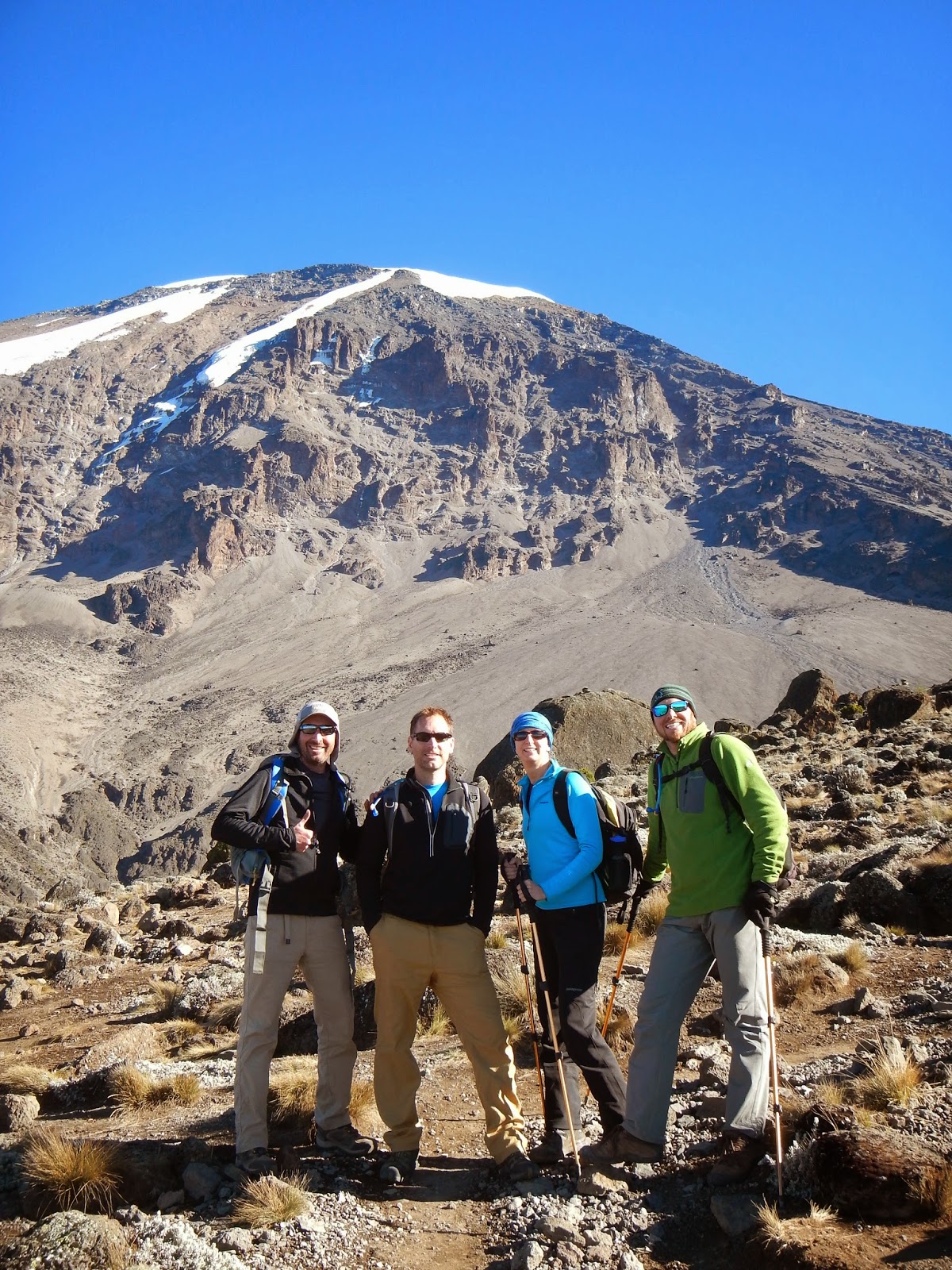
I may have been smiling in the photo from my last post, but I was more nervous than I will ever truly admit.  This was definitely our biggest, most involved excursion to-date, and I had my doubts.  But, in the end, everything turned out just fine.  I'm not going to say it was easy, but it definitely wasn't as difficult as I thought it would be.  I was grateful for our significant backpacking, hiking, and climbing experience, which meant we were never forced to step out too far out of our outdoor-adventure comfort zone.  Instead, we just had to deal with the effects of the extreme altitude, the food, and the discomfort of being on a seven-day trek.  Therefore, it was very do-able.

While preparing for Kilimanjaro, I had a difficult time finding many informative blogs on what it's actually like to climb the mountain, so I want to provide a resource for those climbing it in the future.  Almost every account I read before our trek talked about how miserable and difficult reaching the peak can be.  I want to provide a counterpoint to those accounts.  So, over the next couple of weeks, I will be posting journal entries that I recorded while hiking the mountain.  I hope it will provide a very real, but also encouraging account of what it's truly like to Kilimanjaro.

Stay tuned for more...

Tuesday, January 28, 2014

Kili Day

Kili, here we come!

The Road to Kilimanjaro - The Day Before

Ok.  Amsterdam is done and over.  In retrospect, it might not have been the best preparation for Kilamanjaro, but it was good fun, despite the rotten weather.  The skies may have opened up and rained sheets upon sheets of rain on us every single day, but all we had to do was tuck into one of the little Brown Cafe's and everything was ok.  A couple of Heinekens later, we would be dry and warm, and ready to tackle more of the city.  I loved every part of Amsterdam: the cobblestone streets, the old-school architecture, the walk-ability of the entire city.  It was easily the best layover ever.

But now we're in Moshi, Tanzania, at the Springlands Hotel, packed and ready to start the big climb tomorrow.  I think I've freaked myself out over the past couple of weeks, reading way too many blogs of how tough the Kilimanjaro climb can be.  I've been doubting myself and my abilities.  I've scared myself into thinking I might not be able to do this.  I've been beyond nervous.  But I have to keep reminding myself that I'm fit and have been training for this.  We live at altitude, have been snowshoeing in the mountains, and even took that hut trip after Christmas.  If that didn't prepare me for Kili, then nothing will.

Our big hike begins tomorrow.  It's now or never, so I guess we better be ready.  I'll be off the grid for a whole, but a full trip report will certainly follow.  Wish us luck!


Click here to view our pics from Amsterdam.

Thursday, January 23, 2014

A Big Sigh of Relief

Whew! We made it! All joking and dramatics aside, I was really, truly convinced we wouldn't make it to the airport in time.  The roads were horrible, as in highways closing, zero visability, and slicker than slick conditions.  Thank heavens for my parents and their determination to brave the deplorable road conditions and get us to our flight in time.  No sane person would have voluntarily gone out in those conditions, yet they did.  Amazing.  And, here we are, somewhere over the Atlantic, on our way to the first leg of this crazy adventure.

Amsterdam, here we come!!!

Saturday, January 18, 2014

Detour

Well, here we are, navigating the snow-covered, icy roads of the Midwest, en route to our next big adventure.  When we left Denver, it was sunny and nearly sixty degrees, so all of this cloud-covered winter chill is more than a little deflating as the backdrop for the first days of our vacation.  But this is only a pitstop on the way to bigger and better things; a mere blip on the map of our grand scheme.  In a few days, we will leave all of this Midwest droll behind and find ourselves soaring over the Atlantic, headed for parts unknown. (To us, anyway.).

But first, we're off to Michigan.  It's a strange and moderately inconvenient detour, considering our final destination, but we have a pup to consider, after all, and a little time with Nanna and Poppa will do him good.  So, this is how we have come to find ourselves trekking cross-country, in the middle of winter, slipping and sliding down rural highways, in near white-out conditions.  

No matter, today's drive is nearly over. Good friends, good wine, and amazing food are only an hour away.  And then, ultimately, Amsterdam, followed by Tanzania and the forboding Kilimanjaro.

You see, it's all worth it.

Didn't I tell you I had things worth writing about again?  Let this next adventure begin...

Sunday, October 24, 2010

Hidden Dangers


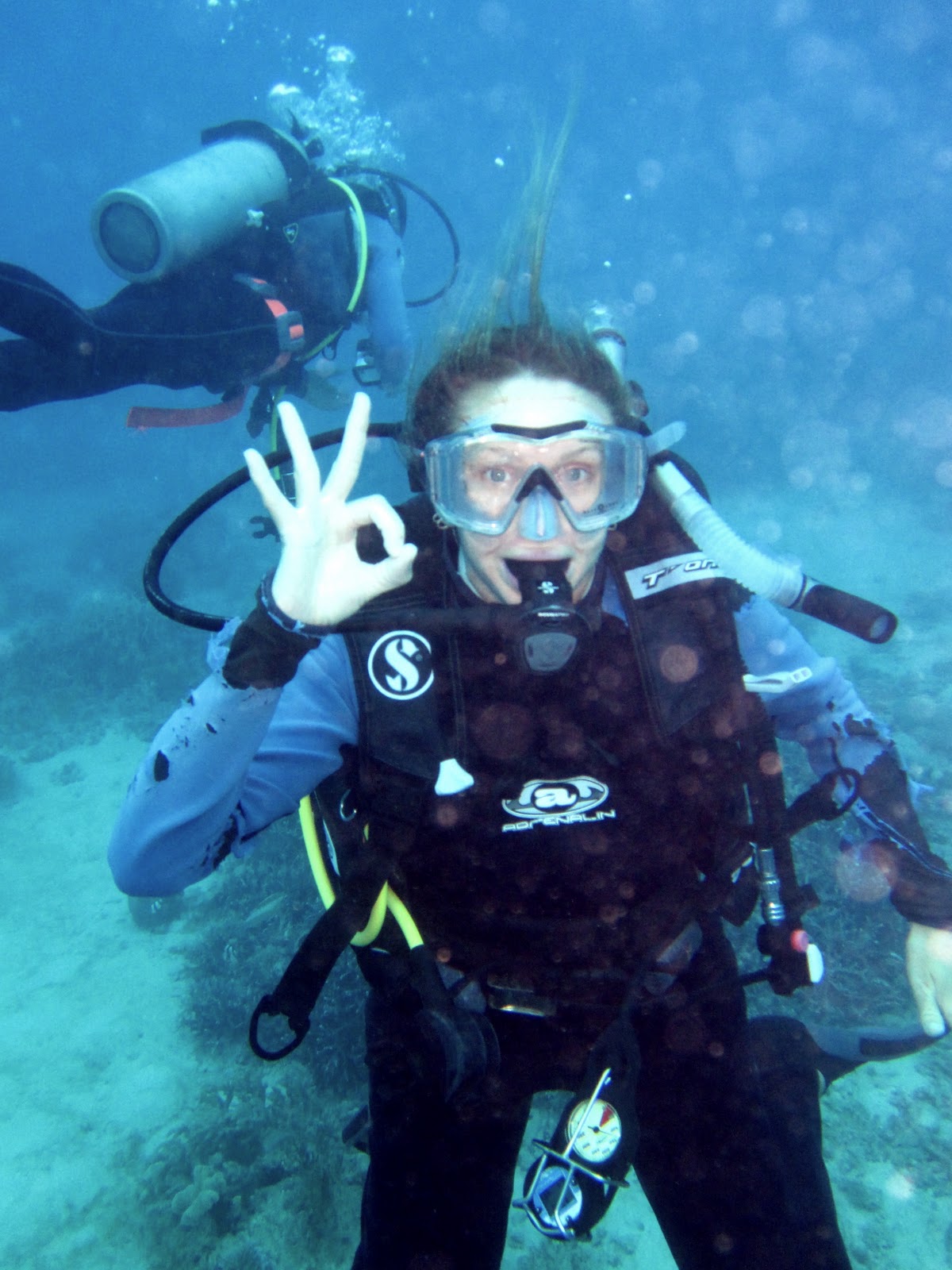
This week, I finally bit the bullet and got around to organizing and uploading the remainder of the photos from August’s Great Barrier Reef diving excursions.  As expected, it was fun to look through them and reminisce, but it also made me think about how my overall impressions of diving have evolved over the past year. 

When Mouse first suggested we get certified to dive, the only thing I could think about was SHARKS.  Even though the idea of exploring the reef up close and personal was inviting, I couldn’t get the frightening mental image of those snaggle-toothed predators out of my head.  Great White Sharks, Grey Nurse Sharks, Blacktip Reef Sharks, Whitetip Reef Sharks… the thought of running into any one of those bad boys set my stomach in knots and my anxiety levels through the roof.  I was terrified, harboring gruesome images of a sadistic shark noshing on my arm for a mid-afternoon snack.  While I wouldn’t say I was paralyzed with fear, I was pretty obsessed with it.  But after living here for a while, and getting some dives under my belt, I’ve come to learn sharks are the least of my worries.  (Although, the recent death of that kid off the coast of California might appear to contradict that thought.)  In all reality, “death by shark” is a highly unlikely event in the waters of Australia, with only 53 occurring in the last 50 years.  And, quite frankly, the sharks I’ve come across could have cared less about me, happily going about their business as I swam by.
 
Nope – when diving The Great Barrier Reef (or simply frolicking in the waters surrounding it), sharks are definitely not the biggest danger.  The real dangers are much smaller and less apparent.  The problem is, people are lulled into a sense of safety because these creatures lack the flash and panache of a Great White.  They’re sneaky like that.  I’ve come to learn, the waters of northern Queensland are teeming with things just waiting to inflict unimaginable pain and possible death onto unsuspecting victims.

The most infamous of all is probably the Box Jellyfish (better known as a marine stinger around here), which is nearly transparent, has tentacles up to 9.8 feet in length, and packs enough venom to kill six adult humans.  (I’ve heard horror stories about marine stinger victims that make me cringe.)  And then there’s its more diminutive cousin, the Irukandji Jellyfish, which is only the size of a thumbnail, but one sting can send a person into weeks of excruciating pain for which there is no cure.  The Blue-Ringed Octopus boasts a neurotoxin that leads to cardiac and respiratory arrest, as well as motor paralysis.  (There’s no anti-venom for that one, either.)  Even brushing up against a Crown-of-Thorns Starfish results in extreme pain.  (The treatment for which is to stick the affected body part into boiling water in hopes of breaking down the venom.)  Even an innocent looking shell can prove to be deadly, as in the case of the cone shell, which houses a harpoon-like stinger that injects a deadly neurotoxin into the poor soul who innocently picks it up.  (Yikes!)  And if you think you’re safe sticking to the shoreline, think again.  The Stonefish remains hidden in the rocks, with thirteen spikes strong enough to penetrate thick-soled shoes, ready to deliver its highly neurotoxic, and possibly fatal, venom.
 
Knowing all of this, you would think I was crazy to even venture near the Australian waters, let alone go diving in them.  But, it’s really a matter of perspective and taking calculated risks.  Sure, danger is ever-present, but so is beauty.  And, when you consider the statistics, I’m highly unlikely to suffer any injury by any of the above-mentioned seas creatures.  Besides, if I gave into my fear, I would never do anything adventurous or fun.


**Be sure to check out all of my GBR photos in the album shown to the right.  Enjoy!

Saturday, September 18, 2010

Rethinking Mount Barney

After some conversations with coworkers and a couple of Mount Barney locals, I’m no longer disappointed with this week’s lack-luster mountaineering performance.  Turns out, most who recommended the hike had never actually done so themselves, as they deemed it too difficult.  Another admitted she and her husband turned around midpoint because they had run out of time; it took them five hours to reach what took me two hours.  The locals informed me hikers are regularly rescued from the mountain.  And I learned most novices usually go guided.  Note to self… These are all things that would have been helpful to know before I started the hike.  Oh well.  So, in retrospect, I was wise to turn around and call it quits when I did.  Because, let’s face it, a dramatic mountain rescue might be good fodder for the blog, but it wouldn’t be much fun in real life.

Oh –  and it turns out the cows chase everyone.  I guess they’re just plain mean.

Thursday, September 16, 2010

Mount Barney and Me

I’m bruised and battered.  My legs are scratched beyond recognition. My arms and shoulders ache.  My calves and quads are rubber.  I’m exhausted.  I’m so tired, my eyelids are drooping as I write this entry.  Don’t feel sorry for me, though.  I’m not really complaining.  Despite my current state of being, I had an amazing day.  It was one of those wonderfully therapeutic, soul-cleansing days that can only be achieved by getting outdoors and pushing your body beyond its everyday expectations.  I needed this.  I needed to hike and climb and spend time outdoors.  I needed to feel my heart race and my muscles burn.  These are the things that help keep me sane.  These are the things that make me feel alive.

Today’s adventure took me to Mount Barney National Park located in the Scenic Rim Region of Queensland, approximately 2 hours southwest of Brisbane.  I hiked the South Ridge trail, which was meant to take me to the east peak of Mount Barney.  I emphasize meant, because my hike didn’t quite go as planned and I didn’t quite make it to the peak.  (Oops!)  Somehow, I managed to wander off the main trail and found myself on a lesser-traveled secondary trail.  No biggee, right?  I was fine with the bushwhacking and bouldering.  Despite the constant, nagging fear that I was going to run into a very large and very unfriendly snake, it was fun.  Then I found myself scaling some fairly exposed rock slabs and realized this probably wasn’t the safest thing to be doing, especially without a buddy.  So, I shimmied and down-climbed my way back to solid ground, upon which I decided the journey was soo much more important than the destination and headed back to the car.  (Translation:  I was too tired to find the real trail and hike up to the peak.)

Even though today’s hike didn’t go as planned and was slightly tough on my body, it was good for me.  It was good to be out there alone, with nothing but the rocks, trees, and my own thoughts for company.  It gave me time to work through everything that’s been whirling around in my head.  It allowed me to process life’s latest twists and turns.  It may not have been the day that I had envisioned, but it was exactly what I needed.  (Even the cows chasing me down the trail can’t change that sentiment.)

Thursday, September 9, 2010

The Camp Kitchen Rules


One of my favorite things about backpacking through New Zealand and Australia has been the caravan parks.  Weird, huh?  They’re not fancy or luxurious.  Instead, they’re down-to-earth and make me feel more in tune with whatever town we happen to be visiting.  Somehow, when I’m tenting it, I feel like more of a participant in the world around me.  But what I love most about the caravan parks is the community kitchen.  You know how everyone always seems to gravitate to the kitchen at a party?  Well, the same is true at a caravan park.  The kitchen is its heart and soul, hosting a constant flurry of activity, with campers and backpackers bustling about, making one meal or another.  People laugh and converse in a dizzying array of languages, sharing stories and giving advice.  It’s like being part of a big, boisterous family, and provides this amazing sense of community. 

Mealtime in the kitchen is also a voyeuristic wonderland, allowing me to observe small snippets of so many different lives.  As I cook and eat with all of these strangers, I can’t help but wonder what each person’s story is, what journey brought them to this place?  But the most fun part has to be spying on everyone’s meal choices.  I can’t help it.  I’m slightly obsessed.  I have to check out everyone’s food, as it’s such a unique opportunity to see what people from around the world eat.  (And I’m not talking about learning about a particular ethnic cuisine, either.  This is a chance to see what real people on a budget actually cook and eat.)  Sometimes, I’m pretty impressed, as some dishes can look and smell quite tempting.  Other times, I can’t help but wrinkle up my nose, confused as to why anyone would want to eat that.   And, every once in a while, like the time a group of young backpackers dined on nothing but potatoes, I just have to laugh.

So, even though backpacking has been an economical way for us travel, it’s also been incredibly interesting and insightful.  I may occasionally yearn for a private bathroom and crisp, clean sheets, but I still wouldn’t trade these experiences in for anything.  Because, let’s face it, I wouldn’t get half as much entertainment sitting around a fancy-schmancy hotel.

Monday, September 6, 2010

The Long, Aussie Road


When we were planning our road trip up the northeast coast of Queensland, so many people tried to discourage us from driving.  “Don’t do it, mate,” they warned.  They thought we were crazy, vowing we would spend all of our time on the road, leaving us little time to relax.  But we would not be swayed.  First of all, we had too much stuff to lug onto a plane.  With our camping gear and diving equipment in tow, flying was not an option.  Plus, we really wanted to see Australia.  Flying may be fast, but it kills any true sense of adventure.  Besides, after consulting our map and Google directions, we determined we would only be covering approximately 1,700km (1,050 miles), all of which were on the main motorway.  How bad could it be?  We’ve tackled much greater distances back home.  What were all of these Aussies squawking about?

Well, let me be the first to clue you into the fact that 1,000 Aussie miles are nothing like 1,000 American miles.  A distance that should take 12 hours to drive is more likely to take 24 hours.  And, just because a road is labeled as a major highway on the map, does not mean that it is any more than a two-lane, country road.  Really, the Bruce Highway could have been any road in the Midwest, winding us through countless small towns, effectively decimating any hopes we had for keeping a swift pace.  Apparently, the only Aussie qualification for coining a road a “highway” is that it’s paved.  It didn’t take long for us to realize this was going to be a very long haul.

Even though the drive was painfully slow at times, we had a blast.  Yes, the miles wore on us and we eventually became pretty road-weary, but the experience was worth it.  The further north we drove, the further the towns began to spread out.  With each passing mile, the landscape transformed before our eyes, going from city to bush land to sugar cane fields as far as the eye could see.  I don’t know how many thousands of acres of sugar cane we drove past, but the vastness of it was astounding.  Sometimes, we saw nothing but sugar cane fields for hours at a time.  (Come to find out, eastern Australia is one of the largest producers of sugar can in the world, second only to Brazil, churning out 4.5-5 million tons of processed sugar per year.  Wow!)  We saw cane trains, a giant mango, kangaroos, dingoes, and even a massive croc sunning himself on the banks of the river.  We stopped at lonely fruit stands and bought local produce.  And then, just when we thought we couldn’t stand another moment of driving, we reached Cairns.  I can’t say I have any desire to repeat this epic drive anytime soon, but I will say that driving the distance from Brisbane to Cairns is an adventure all in itself and is definitely worth the time and trouble.

Monday, August 23, 2010

Our Ancient Escape


I am dirty and stinky.  I am a dirty, stinky ragamuffin.  After three days of camping at Cape Tribulation in Daintree National Park, with no running water or any other modern convenience, I feel like a dirty hippy.  My hair has taken on a waxen sheen; if I didn’t keep it pulled back in bun, it would either stand on end from all of the grease it’s holding, or twist itself into Rastafarian dreadlocks.  I’m pretty sure I look like one of those college kids who spend their summers following The Dead, or Phish, or whatever jam band is en vogue these days, but the past few days were worth every bit of dirt and grime.

Daintree and Cape Tribulation are nearly as far north as one can possibly go in Queensland.  In fact, this is where the sealed road ends.  After that, it’s only a rickety, uneven dirt track leading to Cooktown, the absolute most northerly settlement this side of Australia, and there really isn’t much to see or do in those parts.  Come to think of it, there really isn’t much to do in Daintree, either, it’s just too remote, but that was kind of our point.  One doesn’t really go to Daintree to do things, one goes to relax and marvel at nature.  Sure, there are a few tourist traps like guided nature hikes and river boat tours to distract you, if desired, but, mostly, one goes to relax and enjoy being so secluded from the rest of the world.

Daintree Rainforest covers approximately 1200 square kilometers and has existed for 110 million years, possibly making it the world’s oldest rainforest.  It boasts animal and plant species that cannot be found anywhere else on earth, like the cassowary (a giant bird with razor sharp claws), the tree kangaroo (yes – a kangaroo that lives in the trees), and the idiospermum australienese, one of the most primative flowering plants that, until recently, was thought to have gone extinct 100 million years ago.  (Thanks, Bill Bryson, for bringing this to my attention!)  But besides being scientifically astounding, Daintree Rainforest is simply aesthetically magnificent.  With its towering trees, twisting vines, and canopies of green leaves, it possesses a mystical quality of ancient preportions.  I don’t think I would have been surprised if a triceratops wandered onto the road, munching away at the surrounding greenery.  Seriously.  Spending time in Daintree is like being in another world. 

And then there are the beaches.  Sure, you have to keep an eye out for jellyfish and crocs, but the beaches are magnificent.  (And marine stinger season doesn't start for another couple of months, anyhow.)  We had the pleasure of camping on Noah’s Beach, a nearly deserted enclave with turquoise waters and soft, white sand.  It was like being at our own, personal resort.  (Minus the swim-up bar and tropical drinks, of course.)  We did nearly everything on the beach.  We ate all of our meals watching the waves roll in.  We played frisbee, read books, and took long, lazy naps.  It was the perfect escape from reality.

So, as you can see, all of this was worth my current state of dirtiness.  Now, if you’ll please excuse me, I need to go get cleaned up.

Friday, August 20, 2010

Lost in Paradise


After Cairns, we ventured further north.  First, to Palm Cove, which was as sleepy and relaxing as Cairns had been boisterous and neon-charged.  Palm Cove was the kind of place where you lazed on the beach all day and then grabbed a bottle of wine to keep you company while you waited for the evening tide to come in.  It was exactly what we needed.

Refreshed and reenergized from our day at Palm Cove, we pushed further north to Port Douglas.  This place is undoubtedly a tropical paradise.  I remember reading about it when forming our travel plans and thinking, “I really want to go there.”  I’m happy to report that reality has lived up to my expectations.  I’m in love. 

In my estimation, Port Douglas is the quintessential northern Queensland town.  It’s like being in a storybook.  The beach seemingly stretches on forever.  And in the distant horizon, mountains canopied with lush, emerald rainforest rise up to create a natural buffer from the rest of the world.  The streets are lined with palms.  The restaurants and pubs all boast sprawling verandas with oversized ceiling fans, all but begging you to stop in for a cool drink.  I could easily, and quite happily, lose myself here forever.

We’ve been here for a couple of days now, and everything about our stay has been idyllic.  We’ve spent our time just as you would expect to in a lazy resort town.  We’ve spent countless hours playing frisbee and bocce ball on the beach.  We enjoyed ice-cold beers in the late afternoon sun.  In short, we’ve been in heaven.

Today, we head even further north, to Daintree National Park and Cape Tribulation, essentially the furthest north one can go in Queensland.  I’m slightly nervous about encountering crocs, but am excited to see more.  This area is supposed to be absolutely unique and simply stunning.  I can’t wait!

Stay tuned for more…

Wednesday, August 18, 2010

Attack!!!

Six days into our northeast Queensland adventure and we’ve managed to elude anything as dramatic or dangerous as a crocodile attack or shark encounter.  Nonetheless, we’re still experiencing our share of frightening Australian wildlife.  We’ve seen spiders that would make the average person’s heart stop.  And today, we awoke to find our tent had become the new super-highway for a colony of weaver ants.  Big deal, right?  An ant associated with the making of baskets or rugs can’t be too bad.  Wrong.  These buggers may sound docile, but were anything but congenial.  The aggressive little bastards didn’t even bother to scurry as we attempted to swipe them off our tent.  Nope – they opted to rear their backsides in an attempt a fight.  We weren’t dealing with ordinary ants.  These were massive, in-your-face, not-scared-of-humans ants.  This breed was mean and intent upon making a colony on our tent.  It took a lot of bug spray, shrieks, and shaking to get them off our belongings.  This was definitely not how I had expected to begin my morning.  Oh well.  I guess this is all a part of our Australian adventure!

Tuesday, August 17, 2010

Great Barrier Reef - Trip Report


I have to admit, today was pretty amazing.  I was slightly nervous as we suited up for the first dive.  It had been months since our last dive, leaving me skeptical I would remember my training.  Besides, there could be sharks and lethal jellyfish out there.  The thought of swimming smack dab into their habitat was making me question my own sanity.  But, as soon as we hit the water and I took my first breaths of cool, clean, tank air, my jitters dissolved and my mind cleared.  Once I was able to submerse my face and peer at the underwater marvel below me, I felt nothing but curiosity and awe.  It was like floating in space.  I was in a multi-color heaven.  Time was suspended, but in a magical, ethereal way.  My only reminder of reality was my oxygen meter, and even that couldn’t dampen my good time.  We floated through towers of coral, schools of technicolor fish, and everything else you could imagine.  It was like being transported into a Walt Disney movie.  I could have been the Little Mermaid, though not nearly as graceful.  Luckily (for me), we avoided encountering any Great White Sharks or Box Jellyfish.  Instead, it was a blissful, carefree day of diving one of the great wonders of the world.  I couldn’t be happier.

Oh - and I want to say a great big THANK YOU to Tusa Dive for making this great day possible!  They were amazing!  I highly recommend them!


**I apologize for the lack of photos to accompany this trip report.  We do have some great shots, but the Internet out here is too slow to upload anything.  I promise to post the pics as soon as I’m able.